The AURA Technical Booklet is Aurora Acre's scientific case for the world's first regenerative Bambara-Millet protein nutrition system. It presents peer-reviewed evidence that two crops domesticated in the Sahel 4,000 years ago, Bambara groundnut and millet, interlock at the amino acid level to form a complete protein that meets FAO/WHO infant requirements without synthetic fortification. The booklet covers six converging dimensions:
Consumer research across 1,511 shoppers in Chicago and EU-funded blind testing at Universidade Católica Portuguesa confirm the system clears the taste gate.
The science didn't create the approach.
It confirmed what West African farmers already knew.
Download the full booklet to read the evidence.
The booklet walks through the full evidence base behind the A.U.R.A. Core, from the problem it was built to solve to the peer-reviewed protein science, gut microbiome research, and regenerative agronomy that support it. It is written for investors, partners, researchers, NGOs, governments, and commercial buyers evaluating the system on its merits.
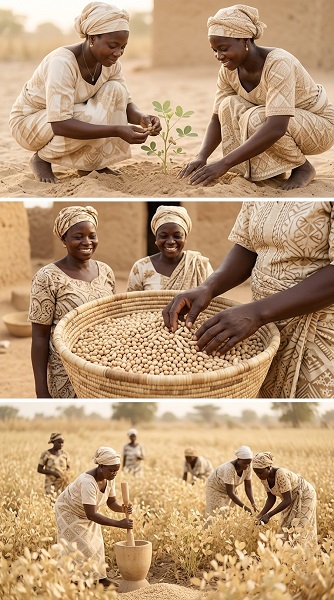
Bambara has always been a women's crop across West and Central Africa. Women plant it, tend it, harvest it, and sell it, and that isn't incidental. Women in smallholder farming contexts tend to reinvest more of what they earn into household food security and children's education, so a crop that strengthens women's income improves child nutrition twice over: once through the food itself, and once through what that income buys.
Aurora Acre's supply chain is structured around that reality rather than treating it as a development outcome to report to funders. No proprietary seed licensing, no dependency on commercial seed companies, and processing that can run at community scale, so the value stays with the people producing it.
Producing one litre of dairy milk takes roughly 628 litres of water once feed-crop irrigation is accounted for. An equivalent serving of protein from the Bambara-millet system, grown rainfed in West Africa, needs no more than 15 litres, and none of it from aquifer drawdown or river diversion. Both crops stay productive on as little as 150 to 300 millimetres of annual rainfall, which is what let them survive in the Sahel for four thousand years without irrigation infrastructure.
Tell us a little about yourself and our team will send the complete AURA Technical Booklet to your inbox, along with the underlying references.
Thank you for your interest in Aurora Acre.
We've received your request. Our team will review it and send the Technical Booklet to your email shortly.